Kauvery Hospital, Alwarpet Performs One of the World’s First complex TAVR-in-TAVR-in-SAVR Procedure with Bioprosthetic Valve Fracture and Dual Cerebral Protection for a man aged 78 years
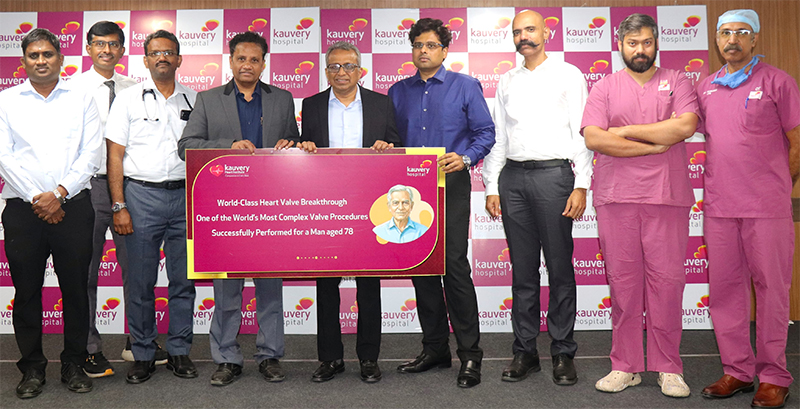
Kauvery Hospital, Alwarpet has successfully performed a highly complex and rare TAVR-in-TAVR-in-SAVR procedure with bioprosthetic valve fracture on a 78-year-old patient, marking one of the first such procedures in the world. The advanced transcatheter intervention was undertaken to treat a repeatedly failing heart valve in a patient with a long and challenging history of aortic valve disease.
The patient was first diagnosed with severe aortic stenosis, a condition where the heart’s main valve narrows and restricts blood flow to the body. In 2005, he underwent open-heart surgery (Surgical Aortic Valve Replacement-SAVR) to replace the diseased valve with a bioprosthetic (tissue) valve. Over time, this valve degenerated, and in 2019, he underwent a transcatheter (TAVR) valve-in-valve replacement—a minimally invasive procedure in which a new valve is placed inside the old surgical valve without reopening the chest.
In the years following the second procedure, the patient once again developed symptoms such as breathlessness and fatigue. Investigations revealed increasing pressure gradients across the valve, indicating that blood flow through the heart valve was again being obstructed. Further evaluation suggested leaflet thrombosis (blood clot in the leaflets) and become thickened, and do not open fully. While anticoagulation medication temporarily improved valve function, the problem recurred whenever treatment was stopped, causing early degeneration of the Transcatheter Heart Valve.
Given the patient’s advanced age, multiple prior valve interventions, and high surgical risk, repeat open-heart surgery was considered a higher risk option.
Upon referral to Kauvery Hospital, Alwarpet, a multidisciplinary heart team led by Dr Rajaram Anantharaman & Dr C Sundar conducted a detailed assessment using advanced 3D echocardiography and CT imaging. These investigations confirmed persistent leaflet thickening and restricted valve opening despite medical therapy, due to under-expandion of the previous placed TAVR allowing leaflets to open in restricted fashion (pin-wheeling). After careful planning, the team decided to proceed with a TAVR-in-TAVR-in-SAVR procedure, placing a new transcatheter valve inside the previously implanted transcatheter valve inside surgical valve.
To further optimise valve expansion and blood flow, a bioprosthetic valve fracture technique was employed. This involves controlled expansion of the existing TAVR in SAVR to high pressure to fracture the frame of the first surgical valve. This will create more space and full expansion of the newly implanted valve, and function more effectively. Given the high neurological (stroke risk) associated with such complex procedures, dual cerebral protection was used during the intervention with two Spider FX devices placed in both Carotids arteries (supplying brain) to reduce the risk of stroke by capturing the debris and preventing from reaching the brain.
The procedure was particularly challenging due to the patient’s bicuspid aortic valve anatomy (two leaflets rather than three) associated aortopathy with moderately dilated aorta (the main artery from the heart was slightly enlarged, increasing procedural risk), and pseudo-coarctation (a narrowing of part of the thoracic aorta with narrowing and tortousity)mimics coarctation, combined with the failure of both a prior surgical valve and a prior transcatheter valve.
Speaking about the case, Dr. Rajaram Ananthraman, Director for Transcatheter Heart Valve Therapies, Kauvery Hospital, Chennai, said,
“The challenging procedure needed meticulous planning and precision by the Heart Valve Team. Despite these complexities, the procedure was successfully completed. The patient showed rapid recovery, was shifted to the ward the next day, and discharged within 48 hours. Post-procedure assessments confirmed excellent valve function, stable neurological status, absence of major complications, and full mobility.”
Commenting on the achievement, Dr. Aravindan Selvaraj, Co-Founder and Executive Director, Kauvery Group of Hospitals, said,
“This case reflects the depth of clinical expertise available at Kauvery Hospital, Alwarpet. Managing such high-risk and complex structural heart cases locally reduces the need for patients to seek care abroad and reinforces Chennai’s growing role as a centre for advanced cardiac interventions.”
Kauvery Hospital, Chennai continues to strengthen its leadership in structural heart disease management through advanced transcatheter procedures, state-of-the-art imaging, and comprehensive multidisciplinary cardiac care, offering patients access to world-class treatment close to home.