
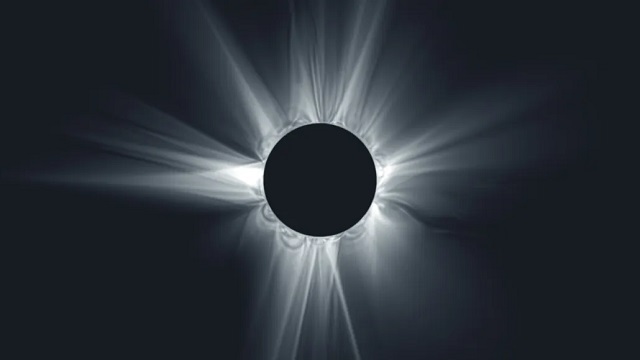
Solar Eclipse Provides Unique Chance to Study Sun’s Mysterious Corona
On August 12, when the Moon blocks the Sun over Greenland, Iceland, and Spain, scientists will have a rare opportunity to study the solar corona, the Sun’s outermost layer. This event offers about two minutes of total eclipse, making it possible for researchers to observe the corona with the naked eye.
For centuries, physicists have been puzzled by why the corona is hundreds of times hotter than the Sun’s surface. On August 12, several research teams will travel to Spain and Iceland to gather data that cannot be collected by space-based instruments. This eclipse is the first of two total eclipses in consecutive years (the next will occur on August 2, 2027), offering scientists a unique chance to advance their understanding.
Amir Caspi, an astrophysicist leading one of the expeditions, explains that researchers aim to solve a long-standing mystery: where does the Sun’s magnetic energy come from and how it heats the corona so much. The solar corona is made up of extremely hot plasma, reaching millions of degrees Celsius.
During total eclipses, the Moon blocks the Sun’s light, revealing the dim corona. While there are methods to block sunlight in space or on Earth, total eclipses provide the clearest images because they reduce issues related to light scattering and diffraction. Shadia Habbal, an astronomer at the University of Hawaii, notes that this is a rare opportunity to observe the Sun’s outer atmosphere.
Habbal’s team will set up five observation sites in Iceland and Spain to maximize their chances of gathering data, even if clouds obstruct some views. They will use spectrometers and high-resolution cameras with special filters to capture light from the corona at specific wavelengths. This helps scientists identify chemical elements and their ionization states, particularly focusing on iron ions, which reveal temperature and structure.
By studying the corona during this eclipse, researchers hope to improve predictions of geomagnetic storms, which can disrupt satellites and cause power outages. For example, a storm in 1989 caused a blackout affecting millions in Canada. Currently, scientists can predict solar plasma events a few days before they reach Earth but only know if they pose a risk when detected by monitoring satellites, about tens of minutes before impact.
Understanding the corona’s processes could help improve these forecasts and better protect Earth’s infrastructure from space weather disruptions.