
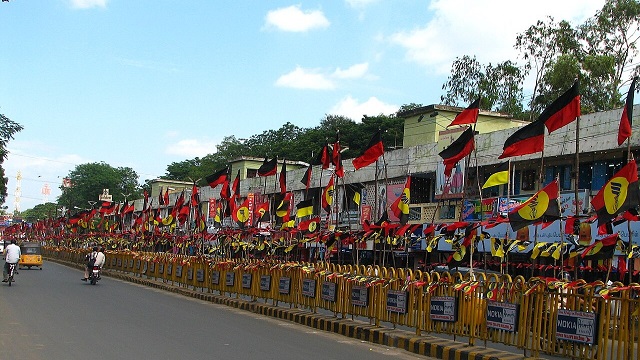
DMK Faces Challenges in the Gen-Z Era
September has a special place in the history of the Dravidian movement in Tamil Nadu. The month is associated with the birth anniversaries of Periyar E.V. Ramasamy and C.N. Annadurai, as well as the founding of the Dravida Munnetra Kazhagam (DMK). The party brings these occasions together under the name Mupperum Vizha, meaning “three grand events.”
Periyar was born on September 17, 1879, while C.N. Annadurai was born on September 15, 1909. The DMK was founded on September 17, 1949. These dates have therefore become important occasions for remembering the history and ideas associated with the Dravidian movement.
For decades, Dravidian politics has played a major role in Tamil Nadu’s political and social life. Issues such as social justice, caste equality, language and state rights have been important parts of the movement’s political identity. The DMK has continued to highlight these ideas during its annual September celebrations.
However, the way younger people connect with politics is changing. Younger voters, including members of Generation Z, are increasingly exposed to different political ideas through social media and digital platforms. Their concerns can include employment, education, technology, economic opportunities and quality of life alongside questions of identity and social justice.
This creates a challenge for political parties that have traditionally relied heavily on historical movements and cultural identity. The DMK continues to emphasize its Dravidian history, but it also has to communicate how those ideas relate to the everyday concerns of younger generations.
The change does not necessarily mean that young people have completely moved away from Dravidian ideas. Instead, the way they engage with politics may be different from earlier generations. Social media, online discussions and rapidly changing career and education opportunities have created new ways for young people to understand political issues.
The 2026 Mupperum Vizha itself has also reflected the current political environment. The event was originally scheduled for September 15 but was postponed after DMK president M.K. Stalin developed a viral fever. The party later announced that the celebration would be held on September 19 at Kalaignar Arangam in Anna Arivalayam, Chennai.
The annual celebration therefore remains an important part of the DMK’s political calendar. At the same time, the changing interests of younger voters mean that traditional political messages are being discussed alongside newer concerns about jobs, education, technology and economic development.
For the DMK, the broader question is how to connect its historical identity with the expectations of a younger and more digitally connected generation. The party’s September celebrations keep its history visible, while its future political relevance will also depend on how it responds to changing social and economic priorities.
The debate reflects a wider change in Tamil Nadu politics. Historical movements continue to influence public life, but political parties must also communicate with voters whose experiences, expectations and sources of information are different from those of previous generations.