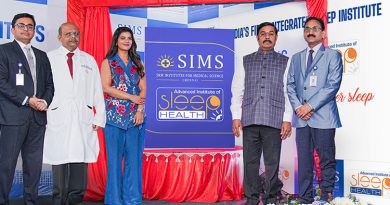

SIMS Hospital Launches India’s First Integrated Sleep Institute, Unifying 10 Specialties Under One Personalised Care Model
Marking a major milestone in India’s sleep care landscape, SIMS Hospital has inaugurated the Integrated Sleep Institute, India’s first fully coordinated, multidisciplinary centre dedicated exclusively to sleep health. Designed to overcome the fragmented approach traditionally seen in sleep medicine, the institute brings together 10 specialties under one structured framework, integrating medical, surgical, diagnostic, and supportive services into a seamless, evidence-based care pathway. With a dedicated sleep board and advanced sleep analysis technologies, the institute offers comprehensive and personalised treatment for neurological, psychological, and respiratory sleep disorders across all age groups.
The institute was inaugurated by the Chief Guest actress Aishwarya Rajesh, who played the lead role in DeAr, a Tamil film portraying the challenges faced by a newly married couple when the wife’s snoring disrupts the husband’s sleep. Dr. Ravi Pachamuthu, Chairman of SRM Group was the Guest of Honour at the event.
The Sleep Institute offers specialised treatment for sleep-related disorders, which are linked to sleep-time cardiac events, and stroke. A multidisciplinary team comprising ENT surgeons, pulmonologists, neurologists, bariatric specialists, oral and maxillofacial surgeons, and conservative dentists work collaboratively to deliver personalised care, adhering strictly to gold-standard protocols. The treatments provided include Positive Airway Pressure (PAP) therapy – CPAP, Auto PAP, BiPAP, and gold standard conservative solutions using advanced, minimally invasive technologies including endoscopic, plasma-based, and radiofrequency (RF) methods that are designed to be precise, bloodless, and painless.
The facility houses a dedicated sleep lab staffed by experienced sleep technologists who conduct attended sleep studies in exclusive cabins. Live, real-time data is captured and analysed to evaluate how sleep impacts physiology, brain function, and cardiovascular health. The institute is equipped to perform DISE (Drug Induced Sleep Endoscopy), conducted using monitoring leads similar to ECG. With the support of an anesthetist, sleep is induced to closely simulate natural sleep, during which a flexible endoscope is introduced into the airway to observe obstructions live and in real time.
The institute provides counselling, and cognitive behavioral therapy (CBT)-based treatment for insomnia and sleep apnea. It also offers specialised sleep optimisation programmes for sports professionals who frequently travel across time zones and need rapid circadian adjustment to remain match-ready.
In her comments, Actress Ms. Aishwarya Rajesh said, “While snoring can be normal, there are disease-related forms of snoring that pose a risk. These may arise from neurological or psychological issues, leading to disturbed sleep, difficulty waking from deep sleep, insomnia, or even involuntary physical actions during sleep. There is also the issue of ‘sleep divorce,’ where a snoring partner is forced to sleep separately. I am happy that with the launch of the Integrated Sleep Institute at SIMS, the city now has a comprehensive solution that can address not just health concerns but also relationship challenges within families that arise out of snoring.”
Speaking about the institute’s vision, Dr. Ravi Pachamuthu said, “We are happy to launch India’s first dedicated multidisciplinary institute for comprehensive sleep care. The Advanced Institute of Sleep Health redefines how sleep disorders are diagnosed and treated in India. Unlike conventional models where patients move between disconnected departments, this institute functions as a fully integrated, multidisciplinary centre. Medical, surgical, diagnostic, and supportive services operate through a unified pathway rather than isolated consultations. We are equipped to manage the complete spectrum of sleep-related conditions – from pediatric to adult – through collaborative, evidence-based protocols.”
Dr. Karthik Madesh Ratnavelu, Director and Senior Consultant, ENT, who heads the Sleep Institute, said, “Stroke and nighttime heart attacks frequently occur in individuals with sleep disorders. In fact, at least three-fourths of patients who experience these life-threatening events have underlying sleep disorders. The problem with snoring is that oxygen intake reduces while carbon dioxide elimination becomes inadequate, leading to serious systemic complications. In many ways, untreated sleep disorders are as risky for heart disease and stroke as cigarette smoking is for cancer.”
Talking about the care delivery model at the Institute, he explained that every patient will be assigned a dedicated sleep navigator, a trained professional who serves as a single point of coordination, guiding the patients through diagnosis, treatment, and follow-up until discharge. The institute’s sleep board ensures shared decision-making. Once investigations are completed, the board, comprising airway specialists, pulmonologists, neurologists, CBT experts, and other specialists, discusses all available options with patients and their families, outlining the benefits and risks of treatments ranging from medication and CBT-based insomnia therapy to surgical interventions. A tailored treatment plan is then finalised with the patient’s informed consent.
On preventive care, Dr. Karthick Madesh emphasised the importance of sleep hygiene: “Waking up at a consistent time helps regulate when we fall asleep. Exposure to morning sunlight suppresses melatonin and triggers cortisol release, which keeps us alert for 12 to 14 hours. Thereafter, melatonin secretion resumes naturally to promote sleep. It is important to avoid arguments and distractions during sleep hours, complete dinner at least two hours before bedtime, and refrain from partying at midnight, late-night eating, or spending entire weekends awake. Such habits disrupt the body’s natural rhythm and increase long-term health risks.”