
India Rejects Pakistan-China Boundary Commission
India has rejected the Pakistan-China Joint Boundary Commission, saying the body has no legal basis to make decisions concerning territories that India claims as its own. The commission held its first meeting in Islamabad, prompting a strong response from New Delhi.
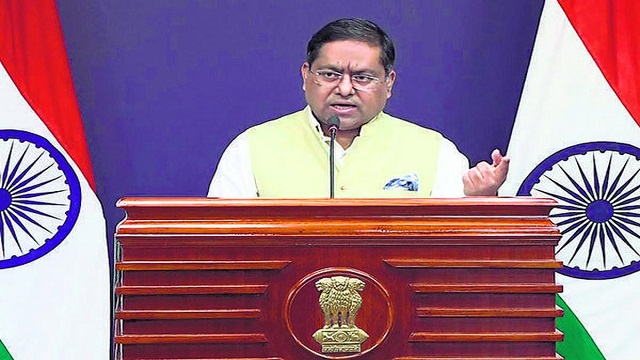
Ministry of External Affairs spokesperson Randhir Jaiswal said India’s position on the issue remains unchanged. He said India does not recognise the commission and maintains that there is no India-recognised boundary between Pakistan and China covering the disputed territories.
India has also consistently rejected the 1963 China-Pakistan Boundary Agreement. According to the Indian government’s position, Pakistan transferred about 5,180 square kilometres of territory in the Shaksgam Valley to China under the agreement. India says the territory was part of Jammu and Kashmir and therefore could not legally be transferred by Pakistan.
New Delhi has also objected to the China-Pakistan Economic Corridor (CPEC) because part of the project passes through territory that India claims as part of Jammu and Kashmir. India has repeatedly raised this issue with both Pakistan and China.
The MEA has stated that India has never recognised the 1963 agreement and continues to describe it as illegal and invalid. The government maintains that the Union Territories of Jammu and Kashmir and Ladakh are integral parts of India.
India has therefore opposed any move that, in its view, could give legitimacy to arrangements concerning the disputed territories. New Delhi has also called on Pakistan to vacate territories that India says are under Pakistan’s occupation.
The latest disagreement comes amid broader diplomatic tensions involving India, Pakistan and China. While India and China have recently worked to improve bilateral engagement, their territorial differences remain unresolved.
The dispute over the 1963 agreement and the territories covered by it remains a longstanding point of disagreement in relations among the three countries. India has reiterated that its position on the issue remains unchanged.