
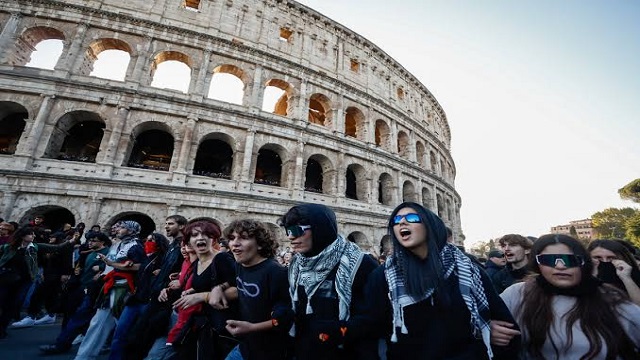
Protesters Enter Rome’s Colosseum During National Demonstrations
Protesters entered Rome’s famous Colosseum during widespread demonstrations across Italy, as tensions increased in several major cities. Police arrested nine people across the country, while hundreds of others were taken to police stations for identity checks and further examination.
According to Italy’s Department of Public Security, 371 people were taken to police stations for checks. The group included 110 minors and 69 foreign nationals. The authorities monitored the demonstrations as large crowds gathered to express their concerns over economic problems, government policies and international conflicts.
The incident at the Colosseum took place when a small group of protesters separated from a larger march along Via Cavour in Rome. They made their way into the ancient monument, where they displayed signs and chanted slogans to draw attention to their demands.
Security personnel later escorted the protesters out of the historic site, allowing the main demonstration to continue. The incident attracted attention because the Colosseum is one of Italy’s most famous landmarks and an important historical monument visited by millions of tourists.
Thousands of people took part in demonstrations in Rome, Florence, Turin and Milan. The protests reflected growing public concerns about the rising cost of living and the economic pressure faced by many households. Increasing expenses for essential goods and everyday needs have become important issues for people struggling to manage their budgets.
The demonstrators also raised objections to policies introduced by Prime Minister Giorgia Meloni’s government. Participants used the protests to express their dissatisfaction with the government’s decisions and demand action on issues affecting workers, families and other sections of society.
Ongoing conflicts in the Middle East were another concern highlighted during the demonstrations. Some protesters wanted greater attention to be given to the humanitarian consequences of the conflicts and called for changes in the government’s approach to international affairs.
The demonstrations brought together people with different concerns, including economic difficulties, political disagreements and opposition to ongoing wars. Large public gatherings in several cities showed how these issues have become part of wider public debate in Italy.
Police continued monitoring the situation and carrying out checks as part of their efforts to maintain public order. The arrests and identity checks came as authorities managed crowds in multiple locations.
The incident at the Colosseum also raised questions about security at important historical sites during large public gatherings. Such landmarks require protection because of their cultural and historical value, particularly when thousands of people gather nearby.
The demonstrations highlighted the challenges facing Italy as the government deals with public concerns over living costs, domestic policies and international conflicts. Further developments will depend on how authorities respond to the protesters’ demands and whether additional demonstrations take place.