
India Votes to End U.S. Embargo on Cuba
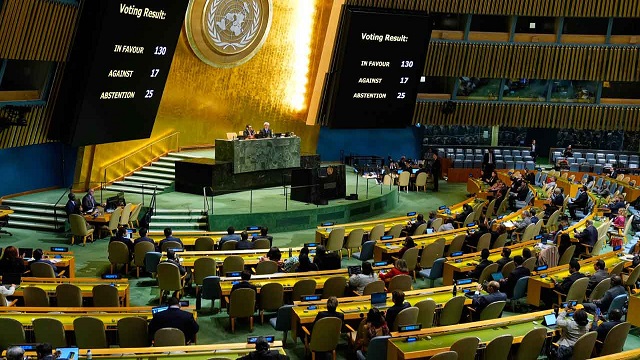
India has supported a United Nations General Assembly resolution calling for an end to the long-standing economic embargo imposed by the United States on Cuba. The resolution was adopted on October 28, 2026, with 130 countries voting in favour, 17 voting against and 25 abstaining.
During the discussion, India’s representative at the UN, Soumya Nair, highlighted the country’s position on the issue. She said the United Nations General Assembly had repeatedly called for the removal of the restrictions imposed on Cuba. She also stressed that all countries should respect international law and follow the principles of the UN Charter.
Nair explained that India believes international problems should be addressed through dialogue, diplomacy and cooperation. She added that lifting the embargo would help Cuba improve its development opportunities and participate more actively in international activities.
The US embargo has placed major restrictions on Cuba’s economic, commercial and financial activities for several decades. According to India’s statement at the UN, these restrictions have affected several important sectors of the Cuban economy, particularly healthcare, agriculture, energy and transportation.
Cuba is currently facing serious shortages of essential medicines and other basic supplies. India’s representative highlighted that the country’s healthcare system faces shortages of more than 60 per cent of essential medicines. Food production has also declined by more than 50 per cent over the past five years, according to the figures she presented.
Restrictions on fuel supplies have further increased the country’s energy difficulties. Shortages have affected electricity production and disrupted essential services, including healthcare, education, water supply, food distribution and transportation.
The conflict between the United States and Cuba dates back to 1959, when Fidel Castro led a revolution that removed the US-backed government from power. Relations between the two countries became increasingly strained after Cuba developed close ties with the Soviet Union during the Cold War. The United States introduced economic restrictions that have remained in place in different forms for more than six decades.
While Cuba argues that the embargo is a major reason for its economic difficulties, the United States has defended its restrictions by pointing to concerns about Cuba’s political system and government policies. The disagreement has continued to affect diplomatic relations between the two countries.
Tensions increased during the UN General Assembly discussions on October 27. US Ambassador Mike Waltz and Cuban Foreign Minister Bruno Rodriguez Parrilla were involved in a heated exchange during the session. The disagreement became serious enough for the General Assembly proceedings to be temporarily suspended before continuing.
Despite the diplomatic disagreement, the General Assembly proceeded with the resolution on October 28. Although 130 countries supported the call to end the embargo, the number was lower than in the previous year’s vote, when 165 countries voted in favour.
The resolution is not legally binding, meaning it cannot directly force the United States to remove its restrictions. However, it represents the position of a large majority of countries at the United Nations and carries considerable diplomatic importance.
India’s support for the resolution reflects its continued emphasis on international cooperation, respect for national sovereignty and peaceful solutions to global disagreements. The vote has once again brought international attention to Cuba’s economic challenges and the long-running dispute between Washington and Havana.