
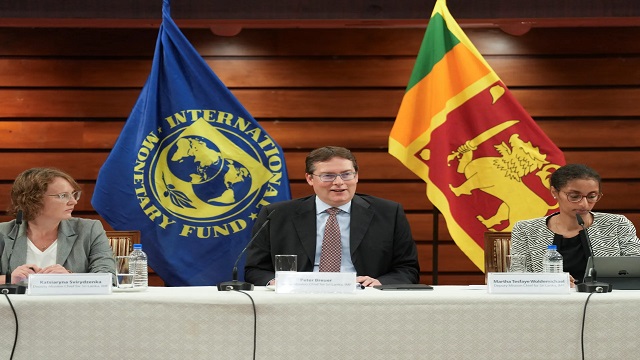
Sri Lanka Economy Stabilises Under IMF Support
Sri Lanka’s economy has improved strongly under the support of the International Monetary Fund (IMF), a senior IMF official said on Wednesday in Colombo.
Dr. Krishna Srinivasan, Director of the IMF’s Asia-Pacific Department, said the country’s economy has “stabilised decisively” after facing a severe financial crisis in recent years. He explained that growth has returned, government tax income has increased, and inflation has fallen sharply.
According to him, Sri Lanka has shown progress in three main areas — economic growth, revenue and inflation. The country’s economy has grown by about 5 percent on average. Tax revenue has nearly doubled, rising from 7.3 percent of GDP to 14.8 percent in 2025. At the same time, inflation, which was once close to 70 percent, has dropped to around 2 to 3 percent.
He said this recovery was possible because of several reforms. These include better control of government spending, restructuring of debt, maintaining price stability and steps to reduce corruption. He added that these measures have helped restore confidence in the economy.
However, the IMF official also warned that Sri Lanka must continue these reforms to ensure long-term stability and growth.
An IMF team recently visited Sri Lanka to study the impact of Cyclone Ditwah on the country’s economy and assess the recovery process. The team completed its visit on Tuesday.
Sri Lanka has also received strong support from India. Since 2022, India has provided about USD 4.5 billion in assistance, including fuel, food, medicines and credit lines. This support helped the country manage shortages and maintain supplies during the worst phase of the crisis.
Officials said that international support along with local reforms has played a key role in helping Sri Lanka recover from its economic troubles.