
How Octopuses Escape Through Tiny Spaces
Octopuses are famous for their ability to escape from small spaces and even aquarium tanks. One well-known example is Inky, an octopus that escaped from an aquarium in New Zealand. These intelligent sea creatures can squeeze through surprisingly narrow openings, making their escape abilities seem almost magical.
Now, scientists have studied how octopuses manage to pass through tiny holes despite having some rigid parts in their bodies.
Most of an octopus’s body is made up of soft muscles, allowing it to change shape and move through narrow spaces. However, certain parts of its body, including the cartilage around its brain, cannot change shape easily.
Robyn Crook, an evolutionary biologist, explained that although octopuses are widely known for their ability to squeeze through small openings, this behaviour has not been studied in detail until recently.
For octopuses, escaping through narrow spaces is not simply a way to avoid captivity. It is an important survival skill that helps them find food, explore their surroundings and escape from predators.
Michael Kuba, a biologist at the University of Naples Federico II, led a research team that studied the escape behaviour of common octopuses (Octopus vulgaris) and Mayan octopuses (Octopus maya).
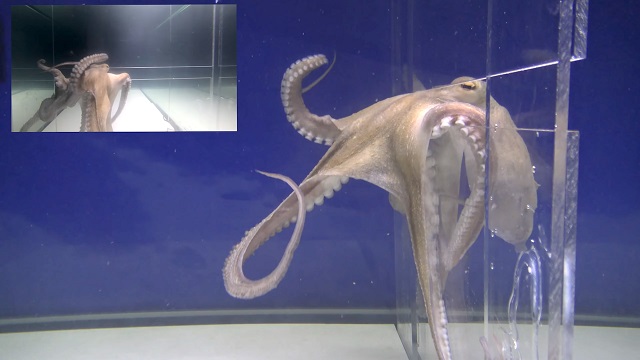
The researchers first measured the distance between the octopuses’ eyes to estimate the size of the rigid cartilage surrounding their brains. They then designed acrylic boxes with small openings that were either slightly larger or smaller than this measurement.
The octopuses were placed inside the boxes, allowing scientists to observe how they attempted to escape through the openings.
The researchers discovered that octopuses adjust their movements depending on the size of the hole. When the opening is large enough to accommodate their rigid body parts, they can carefully change their body shape and move through it.
A common octopus can reportedly squeeze through an opening slightly larger than its most rigid body parts using just three steps.
The findings provide a better understanding of how octopuses use their flexible bodies to escape from tight spaces. They also show how these intelligent animals can adjust their movements to overcome physical challenges.
The research highlights the remarkable flexibility and problem-solving abilities of octopuses, making them some of the most fascinating creatures in the ocean.