
Radiation-Blocking Vest Tested on Artemis I Mission
NASA researchers have tested a special protective vest designed to reduce astronauts’ exposure to dangerous radiation in space. The vest was tested during NASA’s uncrewed Artemis I mission in 2022, which traveled around the Moon and back to Earth.
The 25-day mission did not experience a major solar storm. However, researchers were still able to collect important information about how well the vest could protect astronauts from radiation during space travel.
Radiation is one of the major dangers for astronauts traveling beyond Earth. Our planet is protected by its magnetic field, which blocks much of the harmful radiation coming from space. However, astronauts traveling to the Moon or farther into deep space can face greater exposure.
One important danger is a solar particle event. These events happen when the Sun releases large amounts of high-energy particles, including protons. A powerful solar storm could expose astronauts to dangerous levels of radiation and increase health risks.
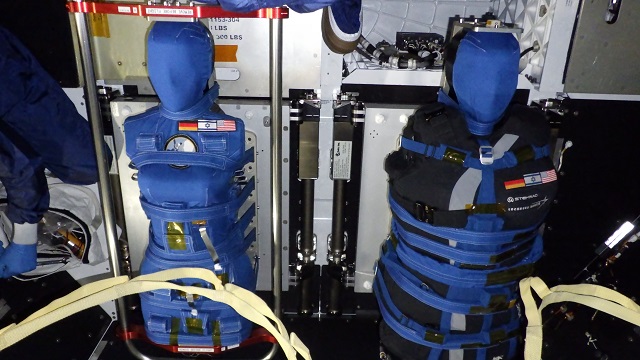
During Artemis I, researchers used two models of female human torsos to study radiation exposure. Both models were equipped with sensors that could measure radiation levels. One model wore the AstroRad protective vest, while the other model did not have the vest.
The AstroRad vest is made mainly from high-density polyethylene, a strong plastic material that can help block radiation. The vest weighs about 57 pounds and was designed to protect important organs that are sensitive to radiation.
These organs include bone marrow, lungs, breasts, ovaries and parts of the digestive system. Protecting these areas is important because radiation exposure can damage cells and increase the risk of serious health problems.
The experiment also studied radiation exposure as the spacecraft traveled through the inner Van Allen radiation belt. This region around Earth contains high levels of charged particles and can be dangerous for spacecraft and astronauts.
Researchers were surprised by the level of protection provided by the vest. Lead scientist Jordan Houri said the results showed that the protective equipment could be useful during future human space missions.
Because Artemis I did not experience a major solar storm, researchers also used information from earlier solar events to estimate how effective the vest could be during a powerful radiation event. Scientists studied data from major solar storms that occurred in 1972 and 1989.
The results suggest that protective clothing such as the AstroRad vest could give astronauts valuable additional protection during periods of high solar activity.
This type of technology could become especially important as space agencies prepare for longer missions. Future astronauts may spend much more time traveling beyond Earth’s magnetic protection, including missions to the Moon and eventually Mars.
A solar storm can occur with limited warning, so astronauts need ways to protect themselves quickly. A wearable protective vest could provide an additional layer of safety without requiring astronauts to stay inside a heavily shielded spacecraft area.
The Artemis I experiment is therefore an important step in understanding how astronauts can be protected from space radiation. While more testing and research will be needed, the results provide scientists with useful information for future missions.
As human space exploration moves farther from Earth, protecting astronauts from radiation will become increasingly important. Technologies such as the AstroRad vest could help make future deep-space missions safer and allow astronauts to explore beyond the Moon with greater protection.