
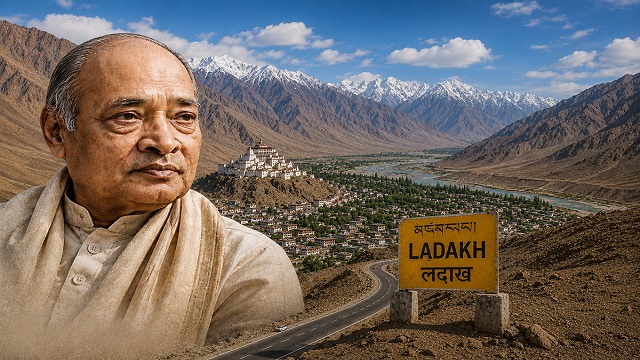
Ladakh: A Lesson in Federalism
In the mid-1990s, during a period of serious conflict in Jammu and Kashmir, then Prime Minister P. V. Narasimha Rao held a discussion with an expert who closely followed the situation in Jammu and Kashmir.
During the meeting, the expert raised an important issue about Ladakh and its system of local administration. A new council had been created to give people in the region greater control over local matters. However, the expert pointed out that the arrangement covered only Leh district and did not include Kargil.
Rao was reportedly surprised by this information. He had believed that the new system applied to the whole of Ladakh. When he asked his officials about it, they confirmed that the expert was correct.
A Bigger Problem
The incident revealed a larger challenge within the government’s understanding of Ladakh. Even at the highest levels of administration, there were gaps in knowledge about the region’s complicated social, political, cultural, and geographical conditions.
Ladakh is a strategically important region because of its location along India’s sensitive borders. It also has different communities, local identities, and political interests. Leh and Kargil, in particular, have their own distinct social and political concerns.
Because of this complexity, decisions made for the region cannot always be based on a single administrative approach.
The Importance of Local Governance
The creation of local councils was intended to give people greater participation in decisions affecting their daily lives. The idea was that local communities would have more control over development and administration.
However, the different treatment of Leh and Kargil showed how difficult it can be to design a system of governance that works equally well across a diverse region.
A policy that appears suitable for one area may not produce the same results in another area. Understanding local concerns is therefore important before introducing major administrative changes.
Lessons From Ladakh
Three decades after the incident, Ladakh continues to offer lessons about federalism, local government, and regional administration.
The experience shows that creating new institutions alone does not guarantee successful self-governance. Governments also need to understand the needs, history, identities, and political expectations of the people living in different parts of a region.
Poorly designed policies can create dissatisfaction and may lead to problems that continue for many years.
The Need for Careful Planning
Ladakh’s experience highlights the importance of detailed research and consultation when dealing with sensitive regions. Government officials need to understand differences between communities and districts before making decisions that affect their political and administrative future.
The story from the Rao era is therefore more than an old political episode. It demonstrates how limited information, incorrect assumptions, and weak planning can create long-term challenges, even when the original intention of a policy is to improve local governance.
For regions as strategically important and socially diverse as Ladakh, effective governance requires a careful balance between national interests, regional needs, and meaningful local participation.