
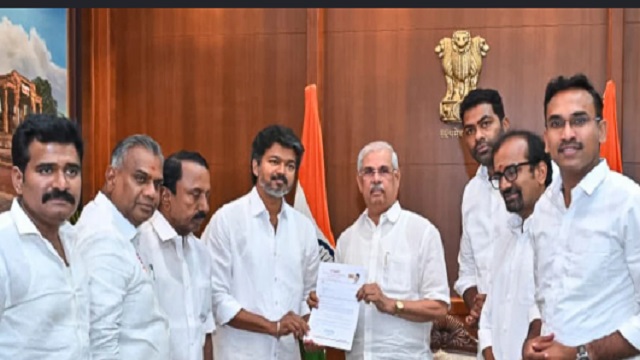
Governor’s Role Crucial in Hung Assembly
The Indian Constitution does not clearly explain the exact procedure to follow when election results produce a hung Assembly, where no single political party wins a clear majority.
In such situations, the responsibility falls on the Governor to act carefully and uphold democratic principles.
If the single largest party seeks the opportunity to form the government, the Governor is generally expected to invite that party first and ask it to prove its majority in the Assembly within a reasonable time.
The makers of the Indian Constitution understood that democracy cannot always function through strict written rules alone.
They recognized that certain political situations require constitutional authorities to act based on democratic values, constitutional morality, and established political conventions rather than relying only on direct constitutional text.
One such complex situation occurs when no party secures enough seats to independently form the government after an election.
Article 164 of the Constitution gives the Governor the power to appoint the Chief Minister and the Council of Ministers.
However, it does not provide detailed instructions for handling a fractured electoral mandate.
This constitutional silence has often led to political debates, legal challenges, and controversies in several states.
Despite this, constitutional experts argue that this lack of rigid rules is not a weakness.
Instead, it is seen as a deliberate design that allows democratic processes within the legislature to determine the final outcome.
By leaving room for political negotiation, floor tests, and legislative decision-making, the Constitution ensures that democratic institutions can resolve uncertainty through elected representatives.
In essence, when election outcomes are unclear, the Governor’s role is to protect the democratic process, not decide political outcomes independently.
This balance between constitutional authority and democratic convention remains crucial in preserving India’s parliamentary democracy.