
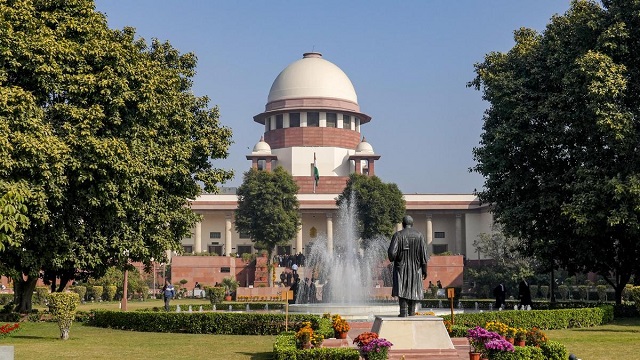
Supreme Court Questions Government Over Vande Mataram Controversy
The Supreme Court of India has asked the central government to respond to petitions challenging the use of the six-stanza version of Vande Mataram as the national song. The petitions argue that this version could create religious divisions and contains elements that may be seen as promoting conflict. The court has issued notices to the government in response to two separate cases and will examine the concerns raised by the petitioners.
A bench led by Chief Justice Surya Kant issued the notices after considering the arguments presented in court. One petitioner, B.D. Borkar, described the six-stanza version of Vande Mataram as a religiously divisive song that resembles a war song. Another petitioner, former bureaucrat Balakrishnan Sathyabhama Mavoji, argued that the move could encourage a system in which religious beliefs influence government policies and public life.
The petitioners claim that making the six-stanza version compulsory would go against India’s secular principles. They argue that citizens belonging to different religious communities should not be forced to participate in a song that they consider connected to particular religious beliefs. They have also challenged government orders issued on January 28 and July 9, claiming that these decisions could increase communal tensions and hurt religious sentiments.
Borkar’s petition focuses on the historical background of the song. Vande Mataram was written by Bankim Chandra Chatterjee in the 1870s and later became associated with India’s freedom movement. The song appeared in Chatterjee’s novel Anandamath, which contains themes connected to religious identity and political conflict. According to the petition, the six-stanza version raises concerns about religious divisions and the idea of one community being superior to others.
The petitioners have also questioned why the longer version should be used when the shorter, two-stanza version has traditionally been used as the national song. They point out that the two-stanza version was used for nearly 79 years after India’s independence without a formal declaration specifying that the longer version must be followed. They argue that the shorter version focuses on praising the motherland through descriptions of its natural beauty and does not require people to express religious beliefs.
The dispute has brought attention to the relationship between national symbols, religious freedom and India’s secular identity. Supporters of Vande Mataram view it as an important part of the country’s independence history and national pride. However, the petitioners argue that respect for national symbols should not mean forcing citizens to follow a particular form of expression that may conflict with their religious beliefs.
The Supreme Court has previously considered questions about whether citizens can be legally compelled to sing or play Vande Mataram. In an earlier case involving T.M. Krishna, the court observed that the government may decide the length of the national song, but it cannot force people to recite particular stanzas. The court also noted that a democratically elected government cannot impose penalties simply because citizens refuse to sing or play the song.
The bench referred to the Supreme Court’s important 1986 judgment in Bijoe Emmanuel versus State of Kerala. In that case, the court protected the religious freedom of students who respectfully stood during the national anthem but did not sing it because of their religious convictions. The judgment established that citizens should not be punished for peacefully following their sincere religious beliefs when they do not disrespect the national anthem.
The latest petitions raise similar questions about the limits of government authority and the protection of individual freedoms. The Supreme Court’s decision to seek a response from the central government does not mean that it has accepted the petitioners’ claims. The government will have an opportunity to present its position before the court considers the matter further.
The case is expected to draw attention to the importance of balancing national traditions with constitutional rights. The central issue is whether the use of the six-stanza version can be required in a way that respects India’s secular values and protects the freedom of citizens to follow their own religious beliefs.