
Madras: One Name, Many Stories
For years, I had planned to research and write about the many stories surrounding how the name Madras came to be, but kept delaying it. Last week, while preparing for a talk at the Madras Institute of Development Studies (MIDS), I finally decided to tackle the topic.
According to the Penneswaramadam inscription from the 14th century, the name Madraspattinam existed long before the English arrived. The Nayak’s grant of 1639 also recognized it as an existing port. However, interest in the origin of the name only began in the mid-19th century and has since grown significantly.
H.D. Love, in his book Vestiges of Old Madras, dismissed a popular story from B. Ramaswami Nayudu about Francis Day naming the city after Madarasen, a local fisherman. Love claimed this was inaccurate. Another theory suggested the name came from a Muslim college (madrasa) in Triplicane, but this was based on a British-built hospital with a dome mistakenly identified as a madrasa.
Some believed the name derived from Mandarajya, meaning “kingdom of the dim-witted,” linked to a mythical king. Portuguese influence was also considered, with some pointing to the Madras De Deus church in Santhome. However, this theory was weakened by the lack of earlier records and conflicting evidence.
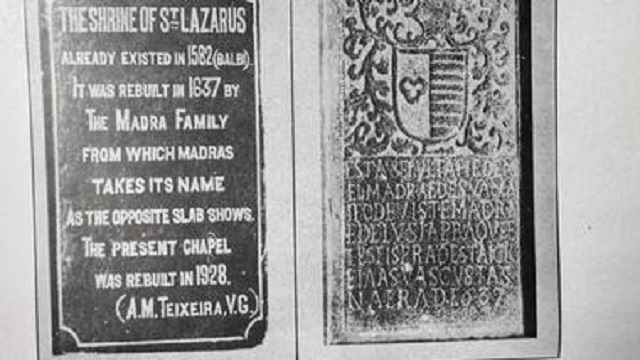
In 1939, during the Madras Tercentenary celebrations, a new theory emerged based on a tombstone found near St. Lazarus Church. It claimed a Portuguese family named Madra had established the city in 1637. This theory gained traction despite later doubts about its accuracy.
Fishermen and boatmen also shared their own theories, suggesting the name evolved from terms related to fishing communities. Meanwhile, Chennapatnam’s origin story centered on Chennappa Nayaka, with no debate over his role.
The name Madras remains a fascinating puzzle, reflecting the city’s diverse history and the many stories tied to its identity.