
New Denisovan Fossils Unveiled in China
A forgotten cave in southwestern China has given archaeologists important new clues about the Denisovans, an ancient human relative whose way of life has remained largely unknown for many years.
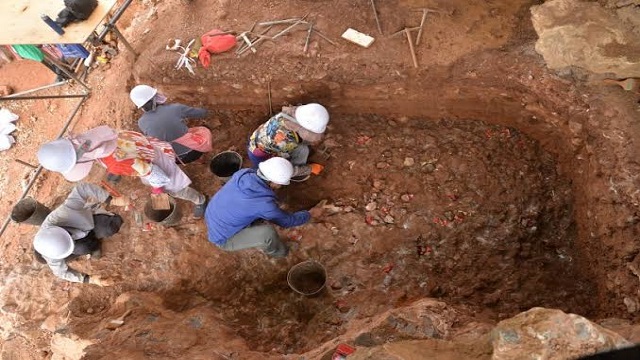
The discovery was made at Bianfu Cave, an archaeological site located in Yunnan Province. The cave was found at an abandoned quarry and has produced a large collection of ancient human fossils, animal remains and stone tools. Researchers say the findings could help them understand how Denisovans lived, what they ate and how they used their surroundings.
Denisovans were an ancient human group that lived across parts of Asia between about 400,000 and 30,000 years ago. They were closely related to modern humans and Neandertals. However, unlike Neandertals, Denisovans have left behind very few known fossils.
Researchers recently examined fossil fragments from Bianfu Cave using advanced scientific methods. Protein analysis and X-ray scans showed that the remains belonged to at least three Denisovans. The individuals are believed to have lived between about 167,000 and 134,000 years ago.
The discovery is especially important because the human remains were found together with other archaeological evidence. More than 1,300 stone tools were recovered from the site. These tools could provide information about the activities Denisovans carried out in the area and how they adapted to their environment.
Animal bones were also discovered at the cave. Some of the bones showed marks that suggest the animals had been butchered. This evidence could indicate that Denisovans hunted or processed animals for food, although researchers will need to study the remains further to understand exactly what happened at the site.
Paleoanthropologist Shara Bailey of New York University said the discovery provides valuable information about how Denisovans lived on the landscape. She noted that Denisovans are becoming less mysterious as researchers uncover more physical evidence about them.
Denisovans were first identified in 2010. Scientists studied DNA from a tooth and a finger bone discovered in Denisova Cave in Siberia. The genetic evidence showed that the remains belonged to a previously unknown group of ancient humans.
Since that discovery, scientists have found evidence that Denisovans had a much wider influence than the small number of fossils might suggest. DNA inherited from Denisovans is present in some modern human populations, including people in parts of the Philippines, Tibet, New Guinea and Australia.
Their genetic influence makes Denisovans an important part of human history. However, understanding their daily lives has been difficult because so few fossils have been discovered. Scientists have had limited opportunities to study Denisovan bones together with tools, animal remains and other evidence from the same location.
This lack of archaeological evidence has been a major problem for researchers. Bence Viola, a paleoanthropologist at the University of Toronto, described the situation as frustrating because scientists have learned much more about Denisovans through genetics than through traditional archaeological discoveries.
The Bianfu Cave findings could begin to change that situation. Because human remains were discovered alongside tools and butchered animal bones, researchers now have a better opportunity to connect Denisovans with specific activities and environments.
The discovery may also help scientists understand how Denisovans survived in southwestern China thousands of years ago. By studying the tools, animal remains and cave environment together, researchers can build a clearer picture of their behavior and lifestyle.
Scientists are expected to continue examining the fossils and archaeological materials from the site. Further research could reveal more about Denisovan diets, technology, movement and relationship with the environment.
Overall, the Bianfu Cave discovery is an important step in understanding one of the least-known groups in human evolution. Denisovans may have disappeared tens of thousands of years ago, but their genetic legacy remains in some modern populations. New archaeological discoveries such as this one could finally help scientists understand the people behind that genetic legacy.