
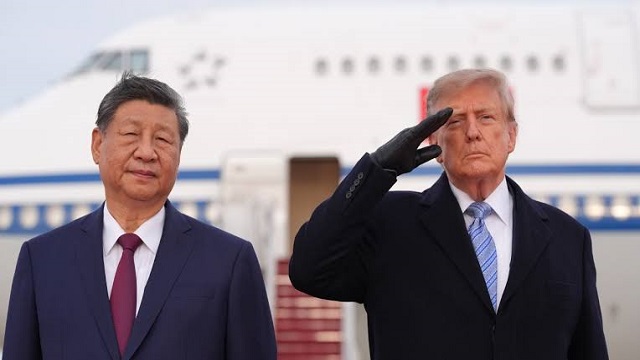
Trump-Xi Truce: China’s Push to Shape Asian Order
U.S. President Donald Trump and Chinese President Xi Jinping are meeting in Washington as the two countries seek to maintain stability in a relationship marked by disagreements over trade, technology, Taiwan and other global issues.
The meeting follows Trump’s visit to Beijing in May, when the two leaders agreed on a vision of building a “constructive China-U.S. relationship of strategic stability.” Xi described the approach as one that would combine cooperation with managed competition and differences that both sides could handle through dialogue.
Expectations for the latest meeting have been relatively limited. Analysts have said that both governments appear focused on managing their differences and preventing tensions from escalating rather than announcing a major transformation in the relationship. Recent reporting has highlighted trade, artificial intelligence, critical minerals and Taiwan as important issues.
Trade and Technology Remain Key Issues
Although the two countries have moved away from the broadest phase of their trade confrontation, several disagreements remain unresolved. The existing trade truce is scheduled to expire in November, creating pressure for Washington and Beijing to determine whether it should be extended. China is seeking greater certainty on tariffs and trade, while the United States continues to view trade measures as an important source of negotiating leverage.
Artificial intelligence has also become a major part of the relationship. Both countries are competing for leadership in advanced AI technology, while officials and experts are discussing ways to prevent technological competition from creating wider security risks.
U.S. officials have proposed mechanisms for communication between Washington and Beijing in the event of serious AI-related incidents. Chinese officials have also called for dialogue while objecting to measures they believe could restrict China’s technological development.
Taiwan Remains a Major Disagreement
Taiwan continues to be one of the most sensitive issues in U.S.-China relations. Beijing considers Taiwan part of China and opposes U.S. military support for the island. Washington maintains its own policies toward Taiwan while continuing security cooperation with Taipei.
Recent reports indicate that China wants the United States to limit military support and arms sales to Taiwan. The issue remains an important source of tension even as both governments attempt to maintain broader stability.
Different Views on the Future of Asia
Chinese strategists have argued that Asian countries should have a greater role in shaping the region’s political and security arrangements. Some Chinese analysts have described this approach through the idea of “Asian solutions to Asian problems.”
At the same time, U.S. allies and partners in the Indo-Pacific continue to closely watch Washington’s engagement with Beijing. Japan, South Korea and other regional governments have emphasized the importance of regional security and stability, particularly regarding Taiwan and freedom of navigation.
Chinese international-relations scholar Da Wei has argued that the changing balance of power between the United States and China could allow the two countries to manage competition without treating their rivalry as an unavoidable existential confrontation. His view is that competition can continue while both sides establish limits and communication channels.
However, other analysts have stressed that major structural disagreements remain. The May summit produced a framework for “strategic stability,” but analysts noted that Washington and Beijing may interpret the concept differently.
For now, the Trump-Xi relationship appears focused on managing competition rather than eliminating it. The two governments are trying to keep communication open while continuing to negotiate over trade, technology, AI, critical minerals and Taiwan.
The outcome of the Washington meeting could therefore provide an indication of whether the two countries can turn their current period of relative stability into a longer-term framework for managing their differences.