
Major Political Shift in Serbia: End of SNS Rule
Serbia has witnessed a major political change after long-time leader Aleksandar Vučić admitted defeat in the country’s parliamentary election. The student-backed opposition movement, known as the Student List, emerged as the leading force in the vote, ending the long period of political dominance enjoyed by Vučić’s Serbian Progressive Party (SNS). The election was held on Sunday, October 25, 2026, and the result has drawn widespread attention across the country.
According to preliminary estimates announced by Vučić, the Student List received around 2.2 million votes, while his political alliance secured approximately 1.72 million votes. The student-backed movement was projected to win between 135 and 140 seats in Serbia’s 250-member Parliament, compared with around 105 seats for Vučić’s alliance. Final official results were still being processed at the time of the initial announcements. <Cite refs={[“turn323905search0″,”turn323905search5”]}/>
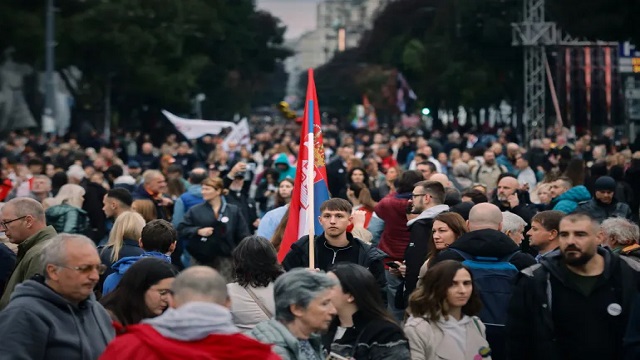
The election became a major contest between the ruling political establishment and a growing opposition movement led by students. For nearly two years, student-led protests had brought thousands of people onto the streets to demand greater accountability, action against corruption and stronger democratic institutions. The protests gained public support from people who wanted changes in the country’s political system.
The movement gained momentum after a tragic incident in November 2024, when a concrete canopy at the railway station in Novi Sad collapsed, killing 16 people. The disaster led to widespread anger and protests, with demonstrators demanding answers about construction standards, government responsibility and possible corruption. The incident became a major issue in public discussions about transparency and accountability in Serbia. <Cite refs={[“turn323905search5″,”turn323905search1”]}/>
More than 6.4 million people were eligible to vote in the parliamentary election. Voter participation was reported to be close to 70%, making it one of the most closely watched elections in recent Serbian political history. Long queues formed outside several polling stations, while people living abroad also took part in the voting process.
The Student List followed an unusual campaign strategy. Rather than presenting itself as a traditional political party led by a single prominent politician, the movement brought together candidates from different professional and social backgrounds. Its campaign focused on fighting corruption, rebuilding public trust, improving the economy and strengthening democratic institutions. Students played a major role in organising the movement and encouraging people to participate in the election. <Cite refs={[“turn323905search5″,”turn323905search7”]}/>
Vučić had been a central figure in Serbian politics for years. His Serbian Progressive Party and its allies had dominated the country’s political landscape since 2012. Before the election, the opposition accused the government of weakening democratic institutions and allowing corruption to continue. The government and its supporters disputed many of these criticisms, making the election an important test of public opinion.
Following the announcement of the preliminary results, celebrations broke out in Belgrade and other parts of Serbia. Supporters of the Student List gathered in public spaces, cheered and celebrated what they viewed as a major political victory. Security personnel were deployed to maintain order as large crowds gathered during the celebrations. <Cite refs={[“turn323905search5″,”turn323905search9”]}/>
Despite the celebrations, the country now faces the challenge of moving from an election campaign to forming a government and delivering on its promises. The new parliamentary majority will need to address concerns about corruption, economic development, public services and the independence of state institutions. It will also face expectations from supporters who want to see meaningful changes after years of protests.
The election result marks a significant moment in Serbia’s political history. The success of the student-backed movement shows how a protest campaign can develop into a major electoral force. However, the movement’s long-term success will depend on its ability to work together, form a stable government and turn its promises into practical policies.
As Serbia moves into its next political chapter, attention will focus on the final election results, the formation of the new government and the steps taken to address the demands raised during the student-led protests.