
First Radio Waves from an Exoplanet Hint at Alien Auroras
For the first time, scientists have directly detected radio waves coming from a planet outside our solar system. The discovery was made from the young gas giant Beta Pictoris b, giving astronomers a new way to study magnetic fields on distant planets.
The discovery may sound like evidence of aliens, but scientists say the radio signals have a natural explanation. Researchers believe the emissions are produced by auroral activity, similar to the processes that create the northern and southern lights on Earth.
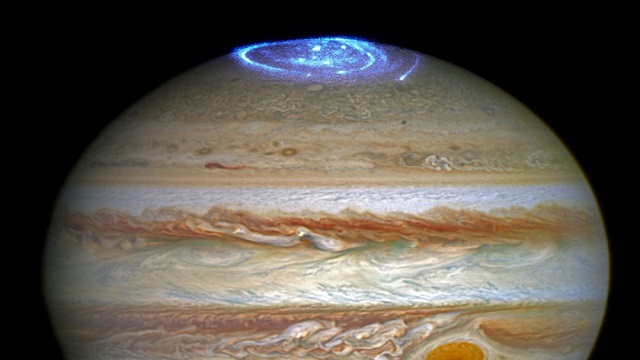
Auroras occur when charged particles interact with a planet’s magnetic field. On Earth, these interactions create colourful displays near the polar regions. Similar auroral activity has also been observed on planets such as Jupiter and Saturn.
Scientists used the MeerKAT radio telescope array in South Africa to observe Beta Pictoris b. The researchers detected rapidly repeating, highly circularly polarised radio bursts as well as continuous radio emission between 0.85 and 3.5 gigahertz. Importantly, the observations were able to link the radio emission directly to the planet rather than simply to its host star.
Beta Pictoris b is a young gas giant located in the Beta Pictoris system, about 19 parsecs, or roughly 63 light-years, from Earth. The planet has been studied for years because of its young age and large size, and it was previously detected through direct imaging.
The radio signals also provided important information about the planet’s magnetic field. The researchers concluded that Beta Pictoris b has a magnetic field of at least 1.25 kilogauss, or about 1,250 gauss. This is far stronger than Earth’s surface magnetic field, which is roughly half a gauss.
The radio emission is believed to be produced through a process called electron cyclotron maser emission. This process occurs when energetic electrons move through a magnetic field and produce radio waves. Because the frequency of this emission is linked to magnetic-field strength, the observations allowed scientists to estimate the planet’s magnetic field directly.
The discovery is important because magnetic fields can influence how planets interact with their surrounding environments. They can help shape atmospheric escape and provide clues about a planet’s interior and its interaction with stellar winds.
Scientists hope that similar radio observations can be used to study other exoplanets in the future. Detecting auroral radio emissions could give researchers a new method for understanding the magnetic properties of worlds far beyond our solar system.
The discovery does not provide evidence of extraterrestrial life. Instead, it offers a new scientific window into how magnetic fields and auroras work on distant planets—and shows how powerful radio telescopes can reveal details that cannot easily be seen using ordinary optical observations.